Suntan RoHS atualizados relatório de ensaio 2.0 para Ceramic Capacitor TS15
http://www.capacitors.hk/Ceramic-Capacitors/TS15.html

Suntan Technology Company Limited
---All Kinds of Capacitors
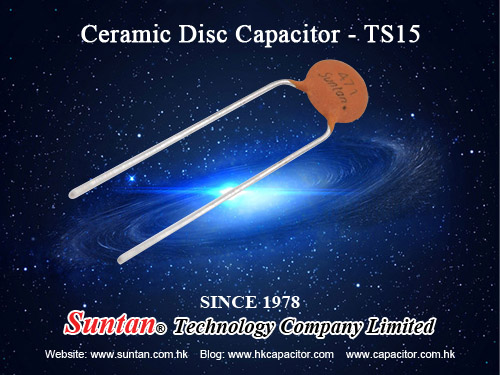
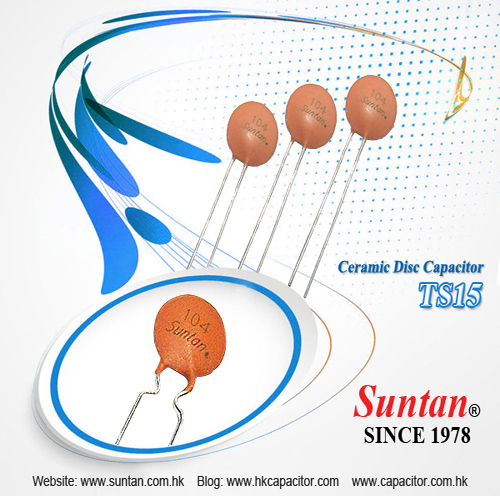
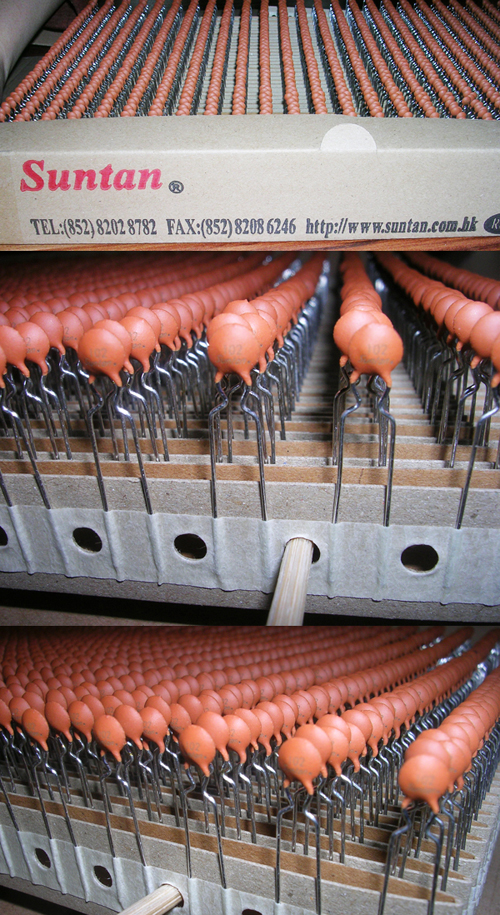
Suntan is a Hong Kong based manufacturer of Ceramic Capacitors. Ceramic Disc Capacitor TS15 is one of our products, but note that its surface marking has upgraded in March 2014 , and we can provide Ammo Packing.
TS15 is ceramic disc capacitor, it has class I temperature compensation and class II high dielectric constant.
Features:
More details please check
http://www.suntan.com.hk/Ceramic-Capacitors/TS15.html
http://www.capacitors.hk/Ceramic-Capacitors/TS15.html
Suntan Technology Company Limited
---All Kinds of Capacitors
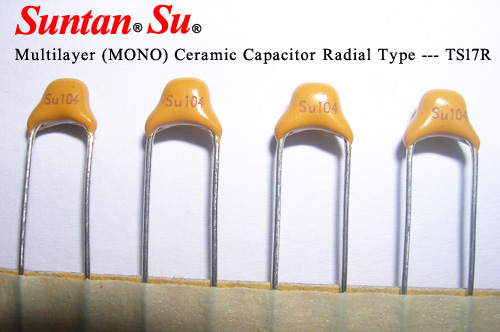
Our Suntan Technology always pay much attention on brand name building and marketing investment. Since year 2013, we even print out trademark Su on Multilayer (MONO) Ceramic Capacitor Radial Type . All the customers can indentify us by this logo, Su is a short name for Suntan. Here we would like to introduce TS17R to everyone.
Based on different material, Multilayer Ceramic Capacitors can be divided to a lot of series.
There are some code name for each materail : NPO(COG), X7R,X5R,Z5U,Y5V,Y5U.
By refer to EIA standard, ceramic capacitors are break down into three categories:
CLASS I: COG(NPO), also called “temperature compensation” type, It is temperature stable or compensating device, it shows very little or no changes in capacitance as temperature change, suitable for timing, impedance matching, ESD/EMI limiting.
CLASS II: X7R,X5R,Z5U,Y5V, also called “high K” type, those material present greater capacitance change than class I type, a variety of dielectric materials are available thus the amount of capacitance change is to be defined from vendor to vendor.
CLASS III: is semiconductor type which exhibit capacitance change similar to class II, however, this type is very rare in consumer application.
Suntan Su Multilayer (MONO) Ceramic Capacitor Radial Type Cross Reference:
| Su Suntan Series | Su Suntan Description | NIC Series | AVX(KYOCERA) | Illinois Capacitor | Kemet | Mallory |
| NCM | SR | *** | C315~C350 | M | ||
| TS17R | Suntan Su Multilayer (MONO) Ceramic Capacitor Radial Type | Panasonic | Phillips | Vishay | Murata | Nippon |
| ECU-S | K, CN,CW,CZ | K (MonoKap) | RPE | THD serie |
Welcome your enquiry about out Su marking Multilayer (MONO) Ceramic Capacitor Radial Type --- TS17R

Suntan Technology Company Limited
---All Kinds of Capacitors
Since 1978, Suntan Technology Company Limited started in selling all kinds of capacitors from our headquarters in Hong Kong, which of course include the ceramic disc capacitor. But what is ceramic disc capacitor? Many people don't really know, Suntan would like to introduce it now.
A ceramic disc capacitor is a capacitor constructed with a ceramic disc as the dielectric. You'll recall that the basic definition of a capacitor is two conductors separated by an insulator (dielectric) of some kind. As a charge is driven onto one plate of a capacitor, the extra charge there builds up an electric field. Each charge arriving on one plate forces a charge off the other plate. Charge (and, therefore, voltage) builds.
After reading the introduction of ceramic disc capacitor, in order to help clients enhance understanding, here take a Suntan products for example . This product is Suntan ceramic disc capacitor - TS15. Suntan ceramic chip capacitor is not only including TS15, of course, also including the TS16, TS17 ,etc.
Ceramic Disc Capacitor - TS15--->CLASS I TEMPERATURE COMPENSATION
SPECIFICATIONS:
OPERATING TEMPERATURE RANGE: -25℃ TO +85℃
RATED WORKING VOLTAGE: DC 50V, 100V, 500V
TEST VOLTAGE: 3 times of the rated voltage
CAPACITANCE: Within the tolerance at 1 MHz, 1±0.2 Vrms. 25℃
Q FACTOR: At 1 MHz. 1±0.2 Vrms. 25℃
C≥30pF ……Q≥1,000
C<30pF ……Q≥400+20℃ (C: Rated capacitance)
INSULATION RESISTANCE: 10,000 MΩmin.
FEATURE:
‧ Linear temperature coefficient of capacitance.
‧ High stability of capacitance.
‧ Low loss at wide ranfe of frequency.
Ceramic Disc Capacitor - TS15--->CLASS II TEMPERATURE COMPENSATION
SPECIFICATIONS:
RATED WORKING VOLTAGE: DC 50V, 100V, 500V
TEST VOLTAGE: 2.5 times of the rated voltage
CAPACITANCE : Within the tolerance at 1 MHz, 1±0.2 Vrms. 25℃
DISSIPATION FACTOR (tan δ): Y5P, Z5U : tan δ ≤2.5%
Z5V : tan δ ≤5%
INSULATION RESISTANCE: 10,000M Ω or 200M Ω μF, whichever is the smaller
FEATURE:
‧ Large capacitance in small sizes.
‧ Non liner temperature coefficient of capacitance.

Suntan Technology Company Limited
----All Kinds of Capacitors
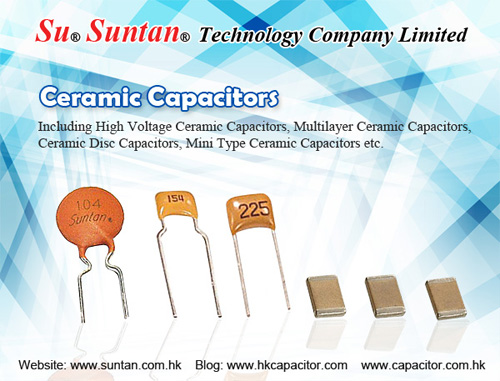
Suntan is a Hong Kong based manufacturer of Ceramic Capacitors. Including High Voltage Ceramic Capacitors, Multilayer Ceramic Capacitors, Ceramic Disc Capacitors, Mini Type Ceramic Capacitors etc.
Please refer to below cross reference : http://www.capacitors.hk/Ceramic-Capacitors/
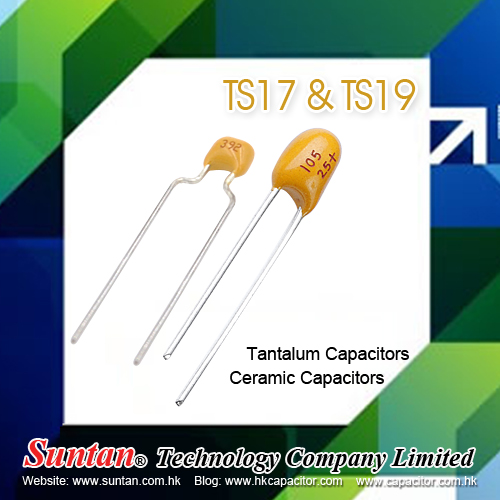
TS17 -Radial Multilayer Ceramic Capacitors (Mono Cap) Cross Guide
| Suntan Series | AVX | Murata | Kemet | Vishay |
| TS17 | SR, SA series | RPE series | C315-C350 | K (Mono Cap) |
| Suntan Series | NIC | Nippon | TDK | Panasonic |
| TS17 | NCM NCMA | THD series | FK Series | ECU-S |
Suntan is a Hong Kong based manufacturer of Tantalum Capacitor. Range includes Dipped Tantalum Capacitors, Chip Tantalum Capacitors, SMD Tantalum Capacitors etc.
Please refer to below cross reference : http://www.capacitors.hk/Tantalum-Capacitors/
TS19 -Dipped Tanlalum Capacitor Cross Reference
| Suntan Series | NIC | AVX | Kemet | Nemco |
| TS19 Series | NDTM | TAP | T350 to T390 | TB PDT |
| Suntan Series | China P/N | Daewoo | NEC | Mallory |
| TS19 Series | CA42 | TB TD series | ND, NP | TDC TDL |

Ceramic capacitor is something that a lot of people would need in order to facilitate their life. If you do not think about this before, this is normal indeed. In fact, there are a lot of devices which are using ceramic capacitors nowadays and you normally would not notice about that. When you are using the internet to browse articles, you are actually using the ceramic capacitors already. Yes, it is because there are a lot of devices which would involve the use of ceramic capacitors and the computer could be one.
A lot of organizations would need ceramic capacitors if you think deeper. Yes, they would need this kind of device to continue their innovative processes in the design of the products which involve the high technology. This is also why a lot of people would try to sell this kind of products through various means.
Suntan Technology Company Limited
---All Kinds of Capacitors
Effect of Frequency: Frequency affects both capacitance and dissipation factor..
The variation of impedance with frequency is an important consideration in the application of multilayer ceramic capacitors. Total impedance of the capacitor is the vector of the capacitive reactance, the inductive reactance, and the ESR. As frequency increases, the capacitive reactance decreases. However, the series inductance (L) produces inductive reactance, which increases with frequency. At some frequency, the impedance ceases to be capacitive and becomes inductive. This point, at the bottom of the V-shaped impedance versus frequency curves, is the self-resonant frequency. At the self-resonant frequency, the reactance is zero, and the impedance consists of the ESR only.

Ceramic capacitors are suitable for moderately high-frequency work (into the high hundreds of megahertz range, or, with great care, into the low gigahertz range), as modern ceramic caps are fairly non-inductive compared to the other major classes of capacitors (film and electrolytic). Capacitor technologies with higher self-resonant frequencies tend to be expensive and esoteric (typically, mica or glass capacitors).
Sample self-resonant frequencies for one set of C0G and one set of X7R ceramic capacitors are:
| 10 pF | 100 pF | 1 nF | 10 nF | 100 nF | 1 µF | |
| C0G (Class 1) | 1550 MHz | 460 MHz | 160 MHz | 55 MHz | ||
| X7R (Class 2) | 190 MHz | 56 MHz | 22 MHz | 10 MHz |
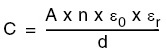
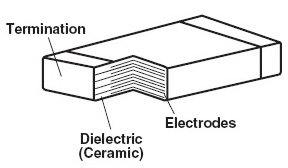
ceramic capacitors consist of electrodes, the interleaved ceramic dielectric and the external terminal connectors. The capacitance is given by the description:

A = Electrode area
n = Number of active layers
d = Distance between electrodes
εr = Dielectric relative
ε0 = Dielectric constant

Whilst the values “A x n” and “d” are respectively determined by the production process the dielectric constant is a function of the ceramic material used.