Why TSR Potentiometers Are Ideal for Industrial Control

Suntan Technology Company Limited – Todos os tipos de capacitores

A linha Suntan TSR abrange uma ampla variedade de potenciômetros e resistores — desde componentes de ajuste de alta precisão até resistores de fio de potência extrema — oferecendo soluções versáteis para controle industrial, instrumentos de teste e projetos eletrônicos.

Cada modelo foi projetado para atender demandas específicas, como ajuste fino de tensão, resistência a altas correntes ou feedback mecânico via codificador rotativo digital. Este guia fornece uma visão geral prática para você entender qual modelo atende melhor à sua aplicação.

Conheça a Linha TSR por Função

Os modelos TSR-01, 02, 04, 06 e 07 utilizam tecnologia wirewound e são ideais para quem busca precisão, linearidade e múltiplas voltas no controle de sinal analógico ou ajuste de tensão. O TSR-03 é compacto, de montagem em placa, e indicado para ajustes manuais em projetos de baixo custo. Já o TSR-08, feito com filme de carbono, se destaca pela operação suave e custo acessível, sendo bastante usado em eletrônicos e áudio.

O modelo TSR-09, com tecnologia de plástico condutivo, oferece longa vida útil e sensação tátil refinada, perfeito para instrumentos e aplicações de áudio. Os modelos TSR-11, 12 e 13 funcionam como codificadores rotativos digitais com clique mecânico, ideais para painéis de controle e interfaces de usuário. Para aplicações de alta potência, os modelos TSR-14, 15 e 16 suportam até 10.000W, vêm com carcaça de alumínio e são recomendados para bancos de carga, sistemas de frenagem e dissipação de energia.

Aplicações em Diversos Setores

Os potenciômetros e resistores TSR são amplamente utilizados em automação industrial, oferecendo ajustes finos em CLPs, controle de servos e processos. Também são aplicados em testes e medições, como calibração de tensão, ajuste de sinal e simulações de carga. No setor de eletrônicos de consumo, são usados para controle de volume, escurecimento de telas e entrada manual. Já em sistemas de potência, atuam como resistores de carga, dispositivos de frenagem e proteção contra sobreaquecimento.

Consulte os Dados Técnicos ou Peça uma Amostra

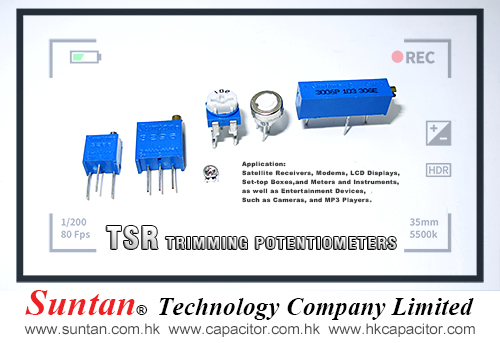
Suntan TSR Series Potentiometers – Visão geral da série

*A imagem exibe apenas alguns modelos. A linha completa está disponível na página do produto.


Todos os tipos de capacitores – Seu parceiro confiável em componentes eletrônicos

Suntan Trimming Potentiometers for precision instrument

Suntan Technology Company Limited
---All Kinds of Capacitors

Nós fornecemos todos os tipos de potenciômetros de corte. Incluindo potenciômetros de corte SMD, potenciômetros de corte retangulares, potenciômeros de corte de wirewould, potenciômetros de corte fenólico e potenciômetros de corte de 5, 6, 7, 8, 9 terminais etc.

Os potenciômetros de corte são usados por cada vez mais produtos, e sua aplicação inclui receptores de satélite, modems, monitores LCD, decodificadores e medidores e instrumentos, bem como dispositivos de entretenimento, como câmeras e MP3 players.
 Suntan Trimming Potentiometers for precision instrument

Su Suntan Small Bubbles, Big Capacitors

Suntan Technology Company Limited
---All kinds of Capacitors

In many ways capacitors are the hidden saving grace of the electronics world. They play an essential role in smoothing switch transitions by storing and releasing a small amount of energy over short time scales. Although inductors can play the same role, I think it is safe to say that without small, accurately valued capacitors the modern electronics industry would be a very different beast. Essentially, capacitors store charge, which means that the amount of charge they can store is related to the area available to put said charges. Over recent years, the development of better control over small scale structuring has lead to large increases in capacitance in relatively small packages. The increases have been such that there have been some thoughts of putting these supercapacitors to work as battery replacements in applications where high currents are required.

On that front we can present some good news. Last month Science reported that scientists had observed an unexpectedly large increase in capacitance in some nanoporous materials. A capacitor at its most simple is a couple of parallel metal plates, where the capacitance increases with the size of the plates and as the two plates get closer together. Unfortunately, increasing the area without too much thought is a quick way to find yourself ordering another 19 inch rack for your capacitors, while sparks, ashes, and electrical fires come from the plates getting too close together. However, an alternative is to roughen the surface and include an electrolyte, which effectively replaces the second plate. This increases the surface area of the plates without increasing the volume. The development of nanoporous materials has lead to dramatic increases in the surface area of capacitors and hence a reasonably sized supercapacitor. Exploring nanoporous carbon for capacitance is nothing new, however, previous methods had very little control over the pore size. Here the researchers developed a different fabrication process that allows them to control the pore size to within 0.05nm. The process begins with a carbide substrate, which is a metal plus carbon atoms. They then etch the metal away by reacting it with chlorine, leaving the surrounding carbon structure intact. Since the amount of metal in a carbide depends on the which metal is used, the pore size can be controlled quite accurately by a good choice of metal and the amount of etching performed.

Once the pore size reduced to that below the electrolyte ion plus surrounding solvent molecules , the effect of the pores was reduced. This is because the increased surface area only works if the distance between the electrolyte and plate remains constant and once the pores get too small the charges on the inside of the pore are too far from the nearest electrolyte ion. However, a further decrease in pore size saw the capacitance increase again. It turns out that when the material is so porous, many of the carbon atoms are just barely hanging on. As a result they can move around quite a bit, which allows the electrolyte to squeeze in. The resulting tight fit between the two means that along with an effective increase in surface area, the gap between the two plates is also decreased. Both of these factors increase the capacitance.

I would say the future looked foamy but my glass is empty.

Page:[«]1[»]