JFL - Metallized Polypropylene Film Capacitor

Jb Capacitors manufactures Metallized Polypropylene Film Capacitor. JFL series is the most common Polypropylene Capacitor, this series with epoxy coating, which have high reliability because of its excellent Self-Healing performance. Jb capacitors sell very competitive prices for Metallized Polypropylene Film Capacitor. Following are our Metallized Polypropylene Film Capacitor features, specifications and drawing.

JFL - Metallized Polypropylene Film Capacitor Features

  • Non-inductive, epoxy dip coated, high moisture resistance.
  • Dissipation factor is normally low and it is stable against high frequency and change of temperature.
  • Remcommended for high-frequency circuits like s-curve compensating circuit.
  • High reliability because of its excellent Self-Healing performance.

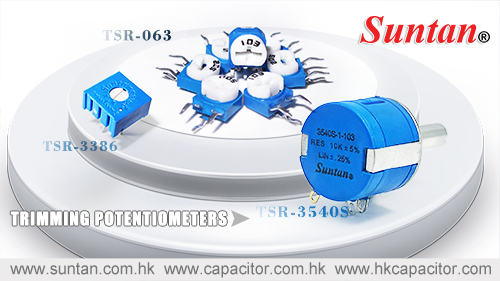
Ceramic Trimmer Potentiometer

Ceramic Trimmer Potentiometer Features

  1. 6mm Round/ Single-Turn/ Cermet Industrial/ Open Frame
  2. Cross slot adjustment options
  3. Horiontal andvertical mounting styles
  4. Dust resistant/ splash resistant covers
  5. PC board stand-offs and retention feature
  6. Front and top adjust styles

Ceramic Trimmer Potentiometer Electrical Characteristics

  1. Standard Resistance Range 100Ω to 1meg ohm
  2. Resistance Tolerance ±20% (TK±25%)
  3. Adjustment Angle 240°C ± 20°C
  4. Residual Resistance ≤500Ω, 10Ω>500Ω, 2% 

Ceramic Trimmer Potentiometer Pictures

Ceramic Trimmer Potentiometer

Circularity Trimming Potentiometers

Circularity Trimming Potentiometers Features

  1. (Single Turn/ Cermet/ Industrial/ Sealed)
  2. (5 Terminal S tyles)

Circularity Trimming Potentiometers Electrical Characteristics

  • Standard Resistance Range 50Ω - 2MΩ
  • Resistance Tolerance ±5%, ±10%
  • Absolute Minimum Resistance ≤1% R or 2Ω
  • Contact Resistance Variation CRV≤3%or 3Ω
  • Insulation Resistance R1≥1GΩ(100Vac)
  • Withstand Voltage 500Vac
  • Effective Travel 280°

Circularity Trimming Potentiometers Pictures

Circularity Trimming Potentiometers

Round Trimming Potentiometers

Round Trimming Potentiometers Features

  1. (Single Turn/ Cermet/ Industrial)
  2. (2 Terminal S tyles)

Round Trimming Potentiometers Electrical Characteristics

  • Standard Resistance Range 10Ω - 2MΩ
  • Resistance Tolerance ±30% std
  • Absolute Minimum Resistance 1% max (≤2K=30Ω)
  • Contact Resistance Variation 3% max
  • Resistance Essentially infinite
  • Adjustment Angle 235° nom

Round Trimming Potentiometers Contact

Trimmer (electronics)

A trimmer is a miniature adjustable electrical component. It is meant to be set correctly when installed in some device, and never seen or adjusted by the device's user. Trimmers can be variable resistors (potentiometers) or variable capacitors. They are common in precision circuitry like A/V components, and may need to be adjusted when the equipment is serviced. Unlike other variable controls, trimmers are mounted directly on circuit boards, turned with a small screwdriver and rated for many fewer adjustments over their lifetime. In 1952, Marlan Bourns patented the world's first trimming potentiometer, trademarked "Trimpot".

Rectangular Trimming Potentiometers

Rectangular Trimming Potentiometers Features

  1. (Multiturn/ Cermet/ Industrial/ Sealed)
  2. (3 Terminal Styles)

Rectangular Trimming Potentiometers Parameters download PDF files Download TSR-3006 - Rectangular Trimming Potentiometers PDF

Rectangular Trimming Potentiometers Electrical Characteristics
Standard Resistance Range 10Ω - 5MΩ
Resistance Tolerance ±5%, ±10%
Absolute Minimum Resistance ≤1% R or 2Ω
Contact Resistance Variation CRV≤1%or 1Ω
Insulation Resistance R1≥1GΩ(100Vac)
Withstand Voltage 640Vac
Effective Travel 22 turns nom

Polypropylene Capacitors

This capacitor is used when a higher tolerance is necessary than polyester capacitors offer. Polypropylene film is used for the dielectric. It is said that there is almost no change of capacitance in these devices if they are used with frequencies of 100KHz or less.

The pictured capacitors have a tolerance of ±1%.

From the left in the photograph
Capacitance: 0.01 µF (printed with 103F)
[the width 7mm, the height 7mm, the thickness 3mm]
Capacitance: 0.022 µF (printed with 223F)
[the width 7mm, the height 10mm, the thickness 4mm]
Capacitance: 0.1 µF (printed with 104F)
[the width 9mm, the height 11mm, the thickness 5mm]

Polyester Film Capacitors

This capacitor uses thin polyester film as the dielectric.

They are not high tolerance, but they are cheap and handy. Their tolerance is about ±5% to ±10%.

From the left in the photograph
Capacitance: 0.001 µF (printed with 001K)
[the width 5 mm, the height 10 mm, the thickness 2 mm]
Capacitance: 0.1 µF (printed with 104K)
[the width 10 mm, the height 11 mm, the thickness 5mm]
Capacitance: 0.22 µF (printed with .22K)
[the width 13 mm, the height 18 mm, the thickness 7mm]

Electric Double Layer Capacitors (Super Capacitors)

  • This is a "Super Capacitor," which is quite a wonder.
  • The capacitance is 0.47 F (470,000 µF).
  • I have not used this capacitor in an actual circuit.

Care must be taken when using a capacitor with such a large capacitance in power supply circuits, etc. The rectifier in the circuit can be destroyed by a huge rush of current when the capacitor is empty. For a brief moment, the capacitor is more like a short circuit. A protection circuit needs to be set up.

The size is small in spite of capacitance. Physically, the diameter is 21 mm, the height is 11 mm.

Care is necessary, because these devices do have polarity.

How Capacitors Work

In a way, a capacitor is a little like a battery. Although they work in completely different ways, capacitors and batteries both store electrical energy. If you have read How Batteries Work, then you know that a battery has two terminals. Inside the battery, chemical reactions produce electrons on one terminal and absorb electrons on the other terminal. A capacitor is much simpler than a battery, as it can't produce new electrons -- it only stores them.

In this article, we'll learn exactly what a capacitor is, what it does and how it's used in electronics. We'll also look at the history of the capacitor and how several people helped shape its progress.

Inside the capacitor, the terminals connect to two metal plates separated by a non-conducting substance, or dielectric. You can easily make a capacitor from two pieces of aluminum foil and a piece of paper. It won't be a particularly good capacitor in terms of its storage capacity, but it will work.